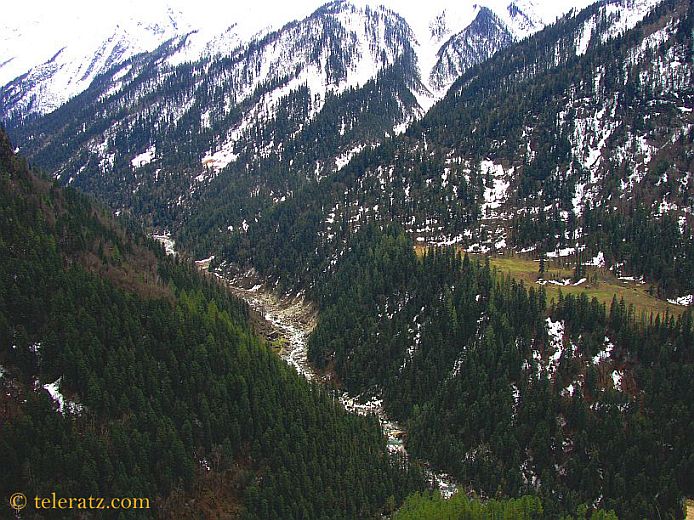
The day was mostly cloudy but it was not until 5 pm when we were well settled in our tents that the snowfall started. Our tents were set up on the snow-covered ground in a clearing just outside the beautiful fir and birch forest. The whole valley lay open in front of us with the green and white playing the game of one-upmanship with each other resulting in a fascinating landscape.
The first few snowflakes floated down on us like soft white feathers and gradually the intensity increased. It was for us to enjoy the serenity of the moments, with only the soft sound of the falling snow in the forest disturbing the silence. We were privileged to be the sole occupants of the valley for that night, so apart from the wild animals there was no one else around.

Then the snowfall got heavy with the flakes increasing in size and then heavier and after a few more minutes we were back in the shelter of our tents. It almost turned into a snowstorm and the severity of it set our guide thinking. Such spells of bad weather are not entirely uncommon in the month of April and he took a quick decision. If this heavy snowfall continued through the night, it would be difficult to hold up our tents; so with just a few minutes of daylight remaining, we decided to move to the permanent shelter of the forest hut at the other end of the valley.
Leaving the tents and our belongings as they were, we just picked up a few essentials. The porters picked up some food for the night and the team started through the storm, trudging through the knee-deep snow. The bright hues of the forest have blurred into monochrome shades by then.

When I started for the Har Ki Dun trekking trip I never thought that I would be actually fleeing for safety from a snowstorm. But the thrill of walking on an unknown terrain in the blinding snowstorm made me forget everything else at that moment. The freezing wind was blowing the snow into our faces and at times I could hardly see anything beyond the blurred outline of the person just ahead of me.
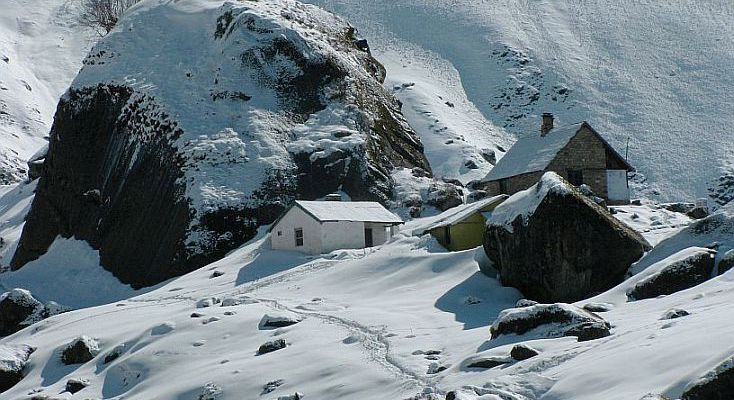
We reached the empty forest hut in the blinding snowfall and as our guide and cook set up the kerosene stove burning, we huddled around it for some warmth. That hut, with its austere settings, was a more reliable shelter than the tent for the eight people in our group. It provided warmth from the freezing temperatures outside and we were tired after our day’s trek and needed nothing more than some space to snuggle inside our sleeping bags.
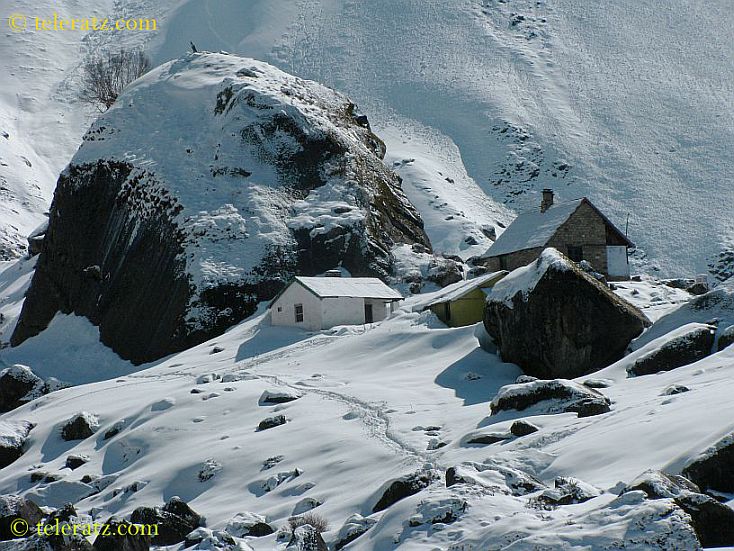
The snowfall continued past 7 pm and then it slowed down. We never thought of going back to the tents and after a quick dinner just did our best to drift off to sleep. Hours later I could see the light filtering in through the cracks in the wooden door and windows and was somehow able to perform the hard task of shaking myself up from my warm corner to take a look outside. The cold was biting and the wind still had its icy touch even though it was much weaker.
The entire Har Ki Dun valley was engulfed in snow and the moon was out in the sky, turning the thick snow silvery with its pale light. The absolute silence that prevailed was almost tangible and one could feel the enchantment brought about by the lack of any sound. The view was too good to be true and it looked like a land sketched out of a fairy tale. It was as if I just needed to walk a few steps into the wilderness to come face to face with mystical beings roaming out there in that magical world.

The next morning was another “Wow” moment for us as we woke up to a landscape that was something beyond captivating. The sun was out in the clear blue sky and the dazzling snow hurt any eyes that were left uncovered. The forests, the crystal clear waters of the river gurgling through the snow, and the high peaks all around us, created an extraordinary scenery. The Swagarohini and Kalanag peaks were shining in all their glory as if to make up for the previous day’s dull weather. That morning, the white expanse of the Har Ki Dun valley offered us one of the best views we ever had in the Himalayas.
Being the only human beings in that huge valley we set out to explore our own paths through the snow, our cameras clicking in frenzy. Due to the heavy snow, it was not possible to explore the Jaundar glacier a few kilometres ahead. After a few memorable moments, we headed back to our tents, had some breakfast and started down for Osla village from the lovely valley.
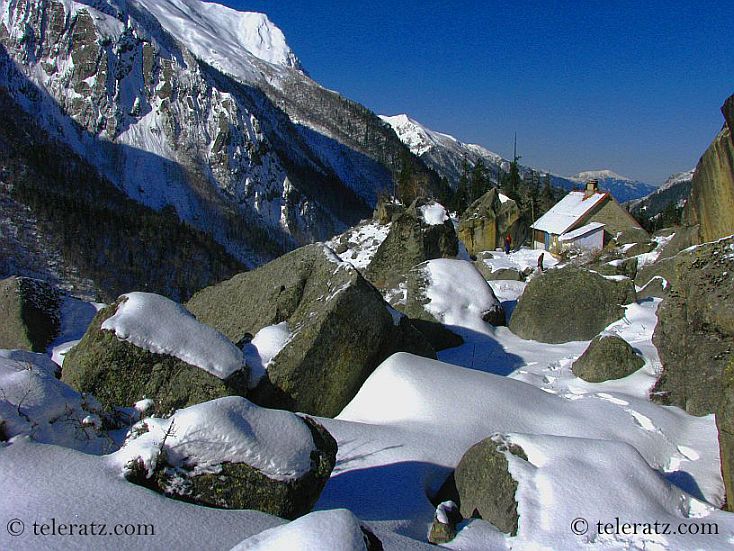
The downhill path was also set up with coats of snow adding a different dimension to the entire landscape. Snow-covered wooden bridges across streams, trees of the dense forests layered with snow and the white peaks and high rising cliffs enhanced the beauty of the path by quite a few degrees. We camped in Osla for the night and the next day headed back for Taluka. The jeep track to the village of Sankri was closed, extending our trek by another 12 kilometers.

Har Ki Dun Trekking Trip Details
For this trek, you need to reach Sankri, which is around 200 km from Dehradun. From Sankri, the 12-kilometer distance to Taluka can be covered in 40 minutes by a vehicle. But, adverse weather can cause the narrow dirt road to remain closed. We had to walk both ways from Sankri to Taluka as the road was closed. However, the trail is easy and provides a good experience of hiking through the Himalayas.
The trekking route to the Har Ki Dun Valley starts from Taluka and moves through the green forests on the banks of the lovely Supin River, crossing the river multiple times over quite a few pretty bridges. Both Supin and her twin sister Rupin join the Tons River which finally merges with the mighty Yamuna. The quaint little villages of Taluka, Gangaad, Osla, and Seema that fall in this route can give a person a true flavour of the rural Himalayas. The smiling villagers, the warm huts, and the beautifully crafted temples, all of it make these villages overwhelmingly charming.
One can experience the idyllic flow of life in these villages or just enjoy a few moments of reverie while basking under the sun on the Supin riverside. If you love exploring legends, visit the temple of Osla village which is said to have links with the Mahabharata era. When you trek through the Himalayas, you will find plenty of trekking trails associated with the legends of the Mahabharata, and Har Ki Dun is no exception.
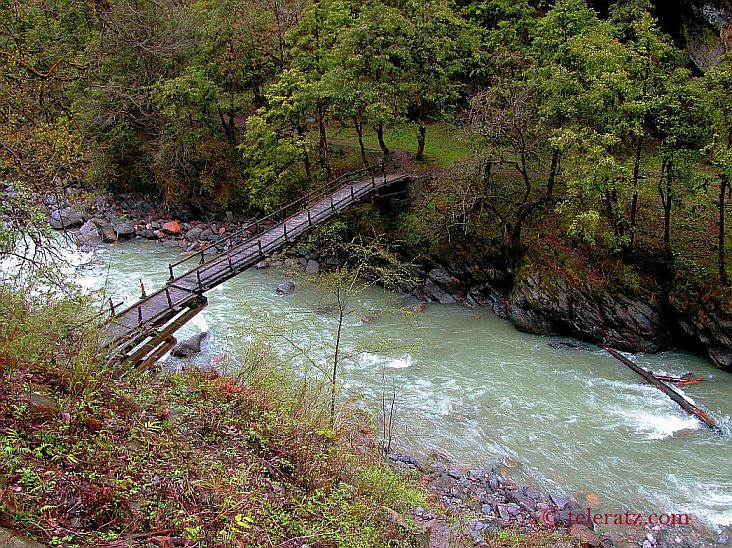
The Har Ki Dun trek is a perfect beginner’s trek or a family trek that can be easily attempted by nature lovers. There are a few stretches of steep uphill tracks in the route but the views are rewarding enough to wash away the strains. For those who want a longer trip, the side trail to Ruinsara Tal can be easily explored by adding another three days to the trip. A route from there crosses the Bali Pass to enter the Yamunotri valley.
Serious trekkers can also cross the Borasu pass from Har Ki Dun to enter the Baspa Valley of the Kinnaur region, which is quite an adventurous route. At an altitude of around 3550 meters Har Ki Dun Valley can be accessed all year round except for the winter months, making it a perfect destination.

Most importantly, carry your supplies for the trek as there are no proper hotels or joints after Sankri. Some basic supplies are available in Taluka and nothing much beyond that. Forest rest houses and GMVN with dormitory arrangements and basic facilities are available in Osla and Har Ki Dun Valley but if you prefer to camp amidst nature, carry your own tents. Winter months are too cold are the valley remains snowbound. The best time to enjoy snow and rhododendrons are from March end to April and for watching the blooming of multi-coloured flowers, monsoon.
A typical itinerary for the Har Ki Dun trek is given under.
Day 1 – Drive from Dehradun to Sankri.
Day 2- Drive from Sankri to Taluka and trek to Osla (10 km)
Day 3- Trek from Osla to Har Ki Dun (8 km)
Day 4- Explore Har Ki Dun Valley
Day 5- Trek to Osla or Seema village
Day 6- Osla or Seema to Taluka and drive to Sankri.

It is easy to get passionate about the beauty of the mountains as these journeys help us to realise how we are not just individuals but resonate as one with nature. This love for the mountains is one of the best addictions life can offer; so listen to the call of the Himalayas and dust off your hiking shoes to prepare for a journey into the beautiful Har Ki Dun valley.
And yes; when you meet the smiling village children with wondrous eyes on the trail, managing their own herd of sheep, or on their way back from the school, don’t forget to share a few candies with them. The waves and smiles that you receive in return are precious and no less beautiful than the Himalayan scenery.
Now, all you have to do is manage your leaves and get going.

By Suvajit Banerjee
© 2018 teleratz.com
 Teleratz